
DevOps Is Overcomplicated: 7 Lessons From Building Real Systems
DevOps has become overly complex. Learn 7 key lessons from real-world systems and how modern teams are simplifying infrastructure, deployment, and scaling.
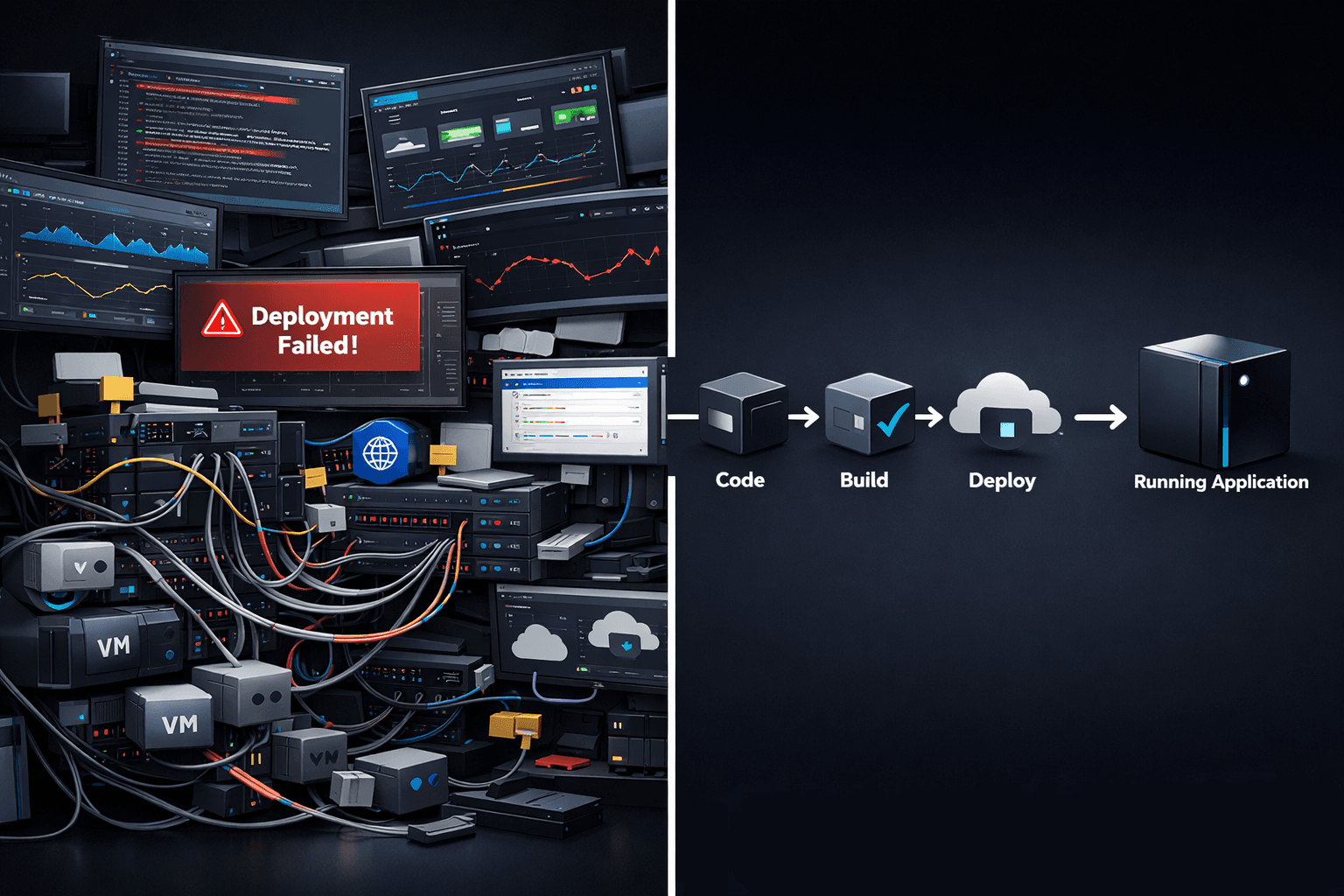
Modern software teams are spending an increasing amount of time managing infrastructure instead of building product. That shift isn’t always obvious at first, but it becomes very clear once you’ve worked through real systems at scale.
In my case, it started with setting up Kubernetes clusters that had multiple interdependent services, each requiring secure communication, proper routing, and consistent availability. Getting the initial system running was already challenging, but what followed was even more demanding: maintaining it. That meant configuring monitoring stacks, managing logs and metrics, setting up alerting systems, and constantly ensuring that nothing silently broke in production.
At some point, the question stopped being “how do we manage this better?” and became something more fundamental: “why does this need to be this complicated in the first place?”
The Reality of Modern DevOps
On paper, the modern DevOps stack is logical and well-structured. Kubernetes handles orchestration, CI/CD pipelines automate deployments, observability tools provide insight into system behavior, and service meshes secure communication between services.
In practice, however, this stack introduces a significant amount of operational overhead.
Getting a Kubernetes cluster running is only the beginning. From there, teams typically need to integrate and maintain a range of additional tools:
- Prometheus for collecting and storing metrics
- Grafana for visualizing those metrics
- Loki or ELK stacks for log aggregation
- Alert manager to notify teams when something goes wrong
- CI/CD systems like Circle CI that evolve as requirements change
Each of these tools solves a real problem. But together, they create a system that is not only complex to set up, but also complex to operate over time.
This complexity doesn’t stay static. As systems grow, pipelines become more intricate, services multiply, and the surface area for failure increases. What begins as a manageable setup gradually turns into an ongoing operational responsibility.
7 Things I’d Tell Any Team Dealing With DevOps in 2026
1. If you need multiple tools just to deploy, it’s already too complex
In many environments, deployment is not a single action but a coordinated sequence involving CI/CD pipelines, infrastructure definitions, environment configurations, and service orchestration. While each component is valuable in isolation, the combination introduces fragility.
Every additional tool increases the number of potential failure points and makes it harder to reason about the system as a whole. When deployment becomes a process that requires orchestration across multiple systems, it is no longer efficient, it is a liability.
2. Infrastructure should be invisible, not something you manage daily
Once a system is in production, infrastructure should not demand constant attention. However, in reality, teams often find themselves continuously monitoring cluster health, reviewing logs, adjusting configurations, and responding to alerts.
This creates a situation where infrastructure management becomes part of the daily workflow rather than a background concern. The issue is not that teams lack the capability to manage infrastructure effectively, but that they are required to do so at all.
3. Most “flexibility” is just unnecessary overhead
Modern infrastructure platforms offer a high degree of flexibility, allowing teams to fine-tune nearly every aspect of their system. While this can be valuable in specific cases, most teams do not require that level of control.
Instead, they need systems that are reliable, predictable, and easy to operate. The additional flexibility often comes at the cost of increased complexity, longer setup times, and higher cognitive load. In many cases, teams end up paying for capabilities they neither use nor need.
4. If debugging requires multiple dashboards, your system is fragmented
A common pattern in modern systems is the fragmentation of observability. Metrics are collected in one tool, logs are stored in another, and traces are accessed through a separate interface.
For example, a team might use Prometheus for metrics, Grafana for visualization, and a log aggregation tool like Loki or Elasticsearch for logs. While each tool provides valuable insights, the need to switch between them creates friction.
Understanding a system should not require navigating multiple disconnected views. When observability is fragmented, debugging becomes slower and more complex than it needs to be.
Viduli Cloud
Viduli Cloud is a platform that makes it easy to deploy and manage your applications by having everything in one place.
5. You don’t need better pipelines - you need fewer steps
CI/CD pipelines tend to evolve over time as new requirements are introduced. What starts as a simple workflow can gradually expand into a multi-stage process with conditional logic, environment-specific configurations, and numerous dependencies.
Tools like GitHub Actions make it relatively easy to build these pipelines, but modifying them as requirements change can become increasingly difficult. Teams often focus on optimizing these pipelines, but rarely step back to question whether the complexity is necessary in the first place.
In many cases, simplifying the system yields greater benefits than further optimization.
6. Scaling should be automatic, not something you actively manage
While modern platforms provide auto-scaling capabilities, scaling is still often treated as a configuration problem. Teams define thresholds, monitor performance, and adjust parameters to ensure systems behave as expected under load.
This approach introduces additional operational overhead and requires ongoing attention. Ideally, scaling should be an inherent property of the system, not something that requires continuous tuning and oversight.
7. The best DevOps setup is the one you barely think about
When a system is well-designed, it becomes unremarkable in day-to-day operation. Deployments are predictable, systems are stable, and debugging is straightforward.
In such an environment, infrastructure fades into the background, allowing teams to focus on building and improving their product. This is the state that most teams aim for, but rarely achieve with traditional DevOps approaches.
The Real Problem
DevOps was originally introduced to bridge the gap between development and operations. It addressed real challenges and enabled teams to move faster and more reliably.
However, over time, it has evolved into a layer of complexity that teams must actively manage. Instead of eliminating friction, it often redistributes it across different tools and processes.
The result is a system where teams spend significant time maintaining the very infrastructure that was meant to simplify their workflow.
A Different Way to Think About It
Rather than focusing on how to improve DevOps processes, it may be more useful to reconsider the role of DevOps entirely.
What if the model were fundamentally simpler?
Instead of configuring infrastructure, managing pipelines, and integrating multiple tools, teams could focus on a single input:
- Provide the application code
- The system handles deployment
- Infrastructure, scaling, and communication are managed automatically
In this model, the path from code to production becomes direct and predictable. The complexity does not disappear, but it is abstracted away from the developer.
Why This Matters Now
The ability to move quickly is increasingly critical for modern teams. Faster iteration leads to faster learning, which in turn leads to better products.
However, speed is not determined solely by how quickly code can be written. It is influenced by the entire system surrounding development, including deployment, monitoring, and infrastructure management.
When these systems introduce friction, they slow down the feedback loop and reduce a team’s ability to adapt. Conversely, when they are streamlined or removed, teams can operate with significantly greater efficiency.
Final Thought
Most teams are still focused on optimizing their DevOps workflows. They invest in better tools, more refined pipelines, and improved monitoring systems.
The teams that move fastest, however, take a different approach. They question whether these workflows should exist in their current form at all.
Where to Go From Here
For technical decision-makers, it is worth evaluating the role that infrastructure plays within your organization.
Consider questions such as:
- How much time does your team spend managing infrastructure compared to building product?
- How many tools are involved in your deployment and monitoring processes?
- How long does it take to move from code to a production-ready system?
The answers to these questions often reveal opportunities to simplify, streamline, and ultimately accelerate development.
A Practical Alternative
For teams looking to move away from managing infrastructure as a daily concern, the shift isn’t about adding more tooling, it’s about changing the model entirely.
This is the approach behind Viduli.
Instead of requiring teams to piece together orchestration, CI/CD, monitoring, and service communication, Viduli provides a system where those components are already integrated and handled by default. You provide your application code, and the platform takes care of deployment, scaling, and service-to-service communication automatically.
Core capabilities like logging, metrics, and health monitoring are built into the platform rather than configured separately, eliminating the need to set up and maintain tools like Prometheus or Grafana manually. Secure communication between services is handled transparently, without requiring custom networking or mTLS configuration.
The result is a more direct path from development to production:
No infrastructure provisioning No pipeline stitching No fragmented observability stack
Just:
code → deployed → running
For teams that want to reduce operational overhead and focus on building product, this represents a fundamentally simpler way to approach modern application deployment.