

API routing without Ingress complexity
Configure path-based routing, SSL termination, and load balancing through an intuitive interface. No Kubernetes Ingress YAML, no annotation hell, no separate gateway provisioning. Just simple, powerful routing.
Route traffic without YAML engineering
Traditional platforms force you to write Kubernetes Ingress resources, configure NGINX annotations, install cert-manager for SSL. Viduli gives you an intuitive API gateway that just works.

Ingress YAML complexity
 Write Ingress manifests with cryptic annotations
 Configure routing through simple UI
SSL certificate management
Install cert-manager, configure issuersAutomatic SSL with Let's Encrypt
Load balancer configuration
Configure external load balancers manuallyIntelligent load balancing built-inConfigure your API gateway in minutes, not days
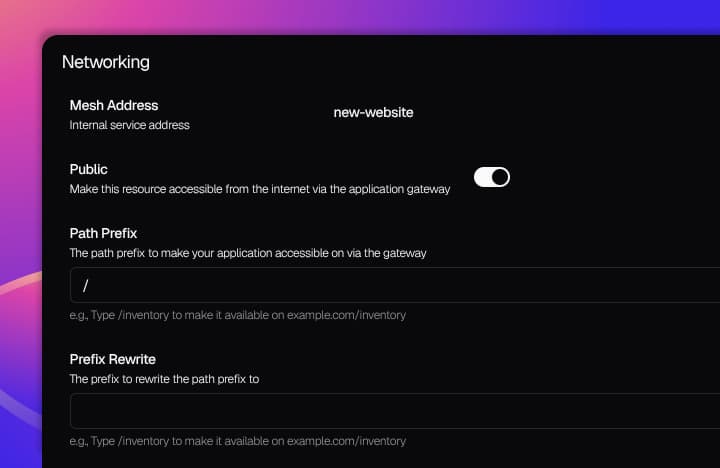
Define routes visually. No Kubernetes knowledge required. Configure path-based routing, path rewriting, and SSL - all through an interface that makes sense.
Path-based routing
Route /api/* to your backend, /admin/* to admin service. Simple prefix matching, no regex confusion.
Path rewriting
Rewrite /api/v1/users to /users at your service. Clean external URLs, flexible internal routing.
SSL termination
Automatic HTTPS with Let's Encrypt certificates. Custom domains with automatic renewal.
Intelligent load balancing
Client-side load balancing via service mesh. No central bottleneck, better performance than traditional gateways.
Enterprise API gateway without Kubernetes expertise
Get all the power of AWS API Gateway, Kong, or Kubernetes Ingress without the configuration overhead. Perfect for REST APIs, GraphQL, microservices, and monoliths.

Path-based routing
Route requests based on URL paths. Multiple services behind one domain. No complex regex patterns or annotations.

Path rewriting
Transform incoming paths before reaching your app. /api/v1/users becomes /users. Clean external APIs with flexible backends.

Automatic SSL/TLS
Free Let's Encrypt certificates provisioned and renewed automatically. Custom domains with HTTPS by default.

Intelligent load balancing
Service mesh provides client-side load balancing. No central gateway bottleneck. Better performance and reliability.

Custom domains
Use your own domains. Configure CNAMEs, and we handle the rest. Multiple domains per application supported.

DDoS protection
Built-in rate limiting and DDoS mitigation. Protect your APIs without additional services.
Every API architecture
Production-ready API hosting
Deploy REST APIs with automatic routing, SSL, and load balancing. Perfect for mobile app backends, SaaS APIs, and integration platforms.
- ✓Automatic HTTPS for all endpoints
- ✓Path-based versioning (v1, v2)
- ✓Built-in request routing
Orchestrate complex architectures
Route traffic to multiple microservices from a single domain. Configure routes per service without managing Kubernetes Ingress.
- ✓Service-based routing
- ✓Path prefix isolation
- ✓Unified API surface
Powerful GraphQL deployment
Deploy GraphQL servers with WebSocket support. SSL termination, routing, and load balancing configured automatically.
- ✓WebSocket support (coming soon)
- ✓Subscription handling
- ✓Single endpoint simplicity
From deployment to production traffic in minutes
Configure your routes once, and traffic flows automatically. Changes deploy instantly without downtime.

Deploy your application
Deploy your service to Viduli. It gets an internal service name automatically for routing.

Configure routes
Define URL paths that should route to your service. Set up path rewriting if needed. No YAML or annotations required.

Add custom domain
Configure your custom domain and point DNS to Viduli. SSL certificate automatically provisioned and traffic flows.
Traditional API gateways vs. Viduli
Enterprise-grade API gateway
Routing
SSL/TLS
Performance
Security
One domain, multiple services
Route different URL paths to different services. Build complex API surfaces without complex configuration.
API versioning
Host v1 and v2 APIs side by side
- ✓/api/v1/* → Service A
- ✓/api/v2/* → Service B
- ✓Graceful migration path
Microservices gateway
Unified API for distributed services
- ✓/users/* → User service
- ✓/orders/* → Order service
- ✓/payments/* → Payment service
Route traffic the simple way
Join developers who've escaped Kubernetes Ingress complexity for intuitive API routing.
Frequently asked questions
Do I need to understand Kubernetes Ingress?
No! You never need to write Ingress resources, understand annotations, or configure Ingress controllers. Configure routes through our intuitive interface - no Kubernetes knowledge required.
How do SSL certificates work?
SSL certificates are automatically provisioned from Let's Encrypt when you add a custom domain. Certificates are renewed automatically before expiration. It just works. No cert-manager or manual configuration needed.
Can I use my own domain?
Absolutely! Add your custom domain in the dashboard, point your DNS CNAME to Viduli, and SSL is automatically provisioned. Both root domains and subdomains are fully supported.
How does path-based routing work?
Define URL path prefixes (like /api, /admin, /public) and map them to your services. Requests matching those paths are automatically routed to the correct service. You can also rewrite paths before they reach your service.
What's different about your load balancing?
Unlike traditional API gateways with a central load balancer (bottleneck), we use service mesh with client-side load balancing. Each instance knows about all healthy backend instances and routes directly for better performance and no single point of failure.
Can I route to multiple services from one domain?
Yes! That's the main use case. Route /api to your backend, /admin to admin service, /blog to your blog. All behind one domain with automatic SSL and load balancing.
Does this support WebSockets?
WebSocket support is coming soon. You'll be able to route WebSocket connections through the same API gateway configuration alongside HTTP traffic.
Can I configure rate limiting?
Rate limiting and DDoS protection features are coming soon. You'll be able to set per-client rate limits, protect against abuse, and configure throttling rules directly in the dashboard.
How is this different from AWS API Gateway or Kong?
AWS API Gateway and Kong are powerful but complex - requiring deep configuration, often with separate provisioning. Viduli's API gateway is built-in to every deployment, configured through a simple interface, and includes automatic SSL and load balancing. No separate service to provision or pay for.